Overview
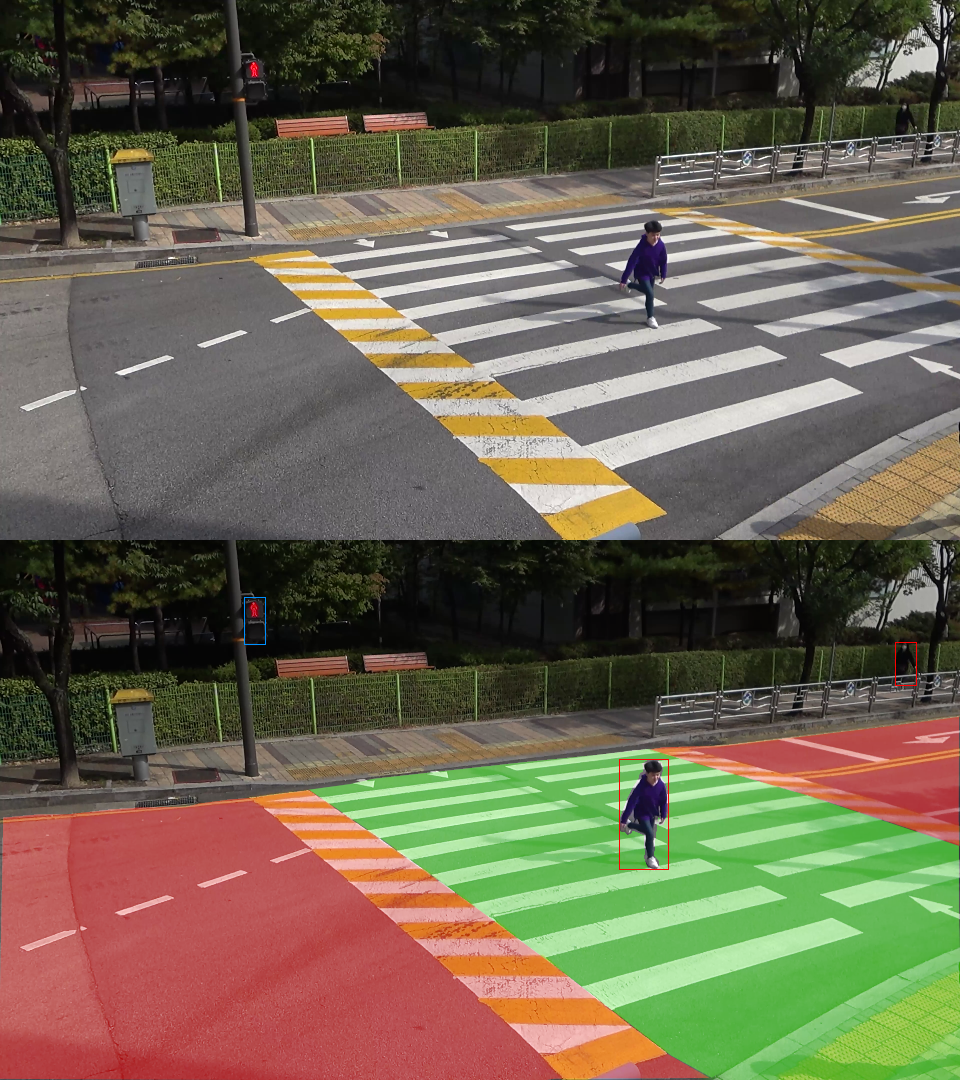
A fixed-CCTV monitoring system for school zones. The system identified whether pedestrians were using designated pedestrian areas or walking in unsafe road regions, and generated an alert when a tracked person entered a configured danger zone.
Objectives
- Combine scene understanding and pedestrian tracking to determine which road region each pedestrian occupied.
- Trigger an alert when a pedestrian entered an unsafe or prohibited area.
My Contribution
- Built the segmentation dataset for road-region understanding, with particular focus on separating roadway and pedestrian-crossing regions.
- Developed the pipeline combining semantic segmentation with real-time pedestrian detection and multi-object tracking.
- Optimized the inference workflow for continuous CCTV monitoring and tuned alert behavior using footage from the target environment.
Architecture
- Train an encoder-decoder semantic segmentation model to identify roadway, pedestrian-crossing, and other relevant scene regions.
- Post-process the segmentation output into a static region map for each fixed CCTV camera, effectively using the segmentation stage as camera-scene calibration.
- Run a real-time person detector with ID-based multi-object tracking on the incoming video stream.
- Compare tracked pedestrian positions with the calibrated region map to determine whether each person is inside a permitted or danger zone.
- Generate structured alert events when a tracked pedestrian enters a configured unsafe region.
Technical Stack
- Python
- OpenCV
- RTSP Video Streaming
- Semantic Segmentation
- Object Detection
- Multi-Object Tracking
- Real-Time Video Processing
- Dataset Engineering
Main Technical Challenges
- Roadway and sidewalk regions could have similar visual appearance depending on lighting and camera angle.
- Night-time footage was limited compared with daytime data.
- Alert thresholds and spatial rules had to be tuned using real CCTV footage to reduce unnecessary false alarms.
- Pedestrian-signal state detection was investigated to distinguish normal crossings from traffic-rule violations, but glare and varying lighting conditions made reliable red/green classification difficult.
Outcome
The completed solution was delivered to the client and satisfied the agreed functional requirements for school-zone pedestrian monitoring and unsafe-area alerting.
Demo